A paradigm shift is required to ensure that shareholders, customers, employees and indeed society at large can benefit from the outcomes of good governance. The advent of the King V Code on Corporate Governance for South Africa 2025 (‘King V’) marks a definitive end to the era of governance as a mere administrative function. With its unwavering focus on outcomes-based performance, integrated thinking, and the strategic governance of Data, Information, and Technology (D.I.T.), King V demands nothing less than a fundamental cultural and behavioural transformation within the organisation.
The true challenge for modern leadership is not just understanding the principles and outcomes of good governance, but in designing the environment where employees are compelled to act in accordance with them. The solution lies in leveraging a digitised governance infrastructure as the strategic enabler for this change.
The core challenge: Changing the why of governance
A "tick-box" mentality prevails when governance is perceived as an external imposition - constraint on value creation. To achieve the deep commitment required by King V, leadership must shift the narrative so that employees (and indeed all stakeholders) view good governance as the most effective pathway to sustainable business performance.
The behavioural catalyst: From subjectivity to objectivity
Traditionally, governance is often limited to an episodic, qualitative compliance exercise, characterised by subjectivity. Unfortunately, this approach allows individuals and teams to minimise accountability and manage perceptions rather than performance. However, by making governance measurable, visible, and performance-based, it is integrated into the core strategy and value creation processes of the organisation.
A digitised governance framework can act as a powerful catalyst by:
- Establishing governance KPIs: It translates abstract principles (e.g., 'prudent control') into quantifiable metrics (e.g., rating the effectiveness of business continuity plans). This forces a behavioural shift from reporting on activity (e.g., 'we held a meeting') to demonstrating achieved governance outcomes (e.g., ‘the effectiveness of monitoring and reviewing business resilience has improved by $x%’).
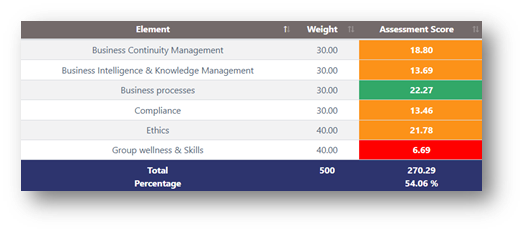
- Creating a data-driven feedback loop: The system provides continuous, evidence-backed assessments of actual performance against expected standards. This real-time visibility prevents governance issues from escalating and requires employees to adopt a proactive, pre-emptive approach to governance, rather than a reactive one.
The organisational mindset therefore moves from one of defensive compliance (ticking boxes to avoid sanctions) to performance ownership (managing measurable KPIs that directly impact business value).
Underpinning the foundational principles of governance
The strength of this digital infrastructure lies in its ability to embed King V’s philosophy directly into the daily workflow, making desired behaviours the most logical and efficient path forward.
1. Outcomes-based governance: The ethical implications of transparency
King V requires demonstrable outcomes across ethical culture, performance, control, and legitimacy. A digitised governance framework’s structured, evidence-based reporting introduces a powerful ethical dimension: transparency.
- Elevating ethical culture: Transparent, objective data on adherence to policy and alignment to governance best practice, leaves little room for ambiguity or cover-up. This visible linkage between actions, outcomes, and accountability enforces the highest level of ethical conduct across the organisation.
- Governing with accountability: Transparency is a prerequisite for accountability. By providing the governing body and stakeholders with clear, measurable insights into governance performance - good or bad - the framework compels leaders to own the outcomes, fostering a culture of moral courage and honesty.
The deployment of a digitised governance framework emphasises to stakeholders, specifically employees, that governance is now under an objective spotlight. This instils a governance consciousness where ethical and effective behaviour is not optional, but a required and visible component of one’s contribution to the organisation.
2. Integrated thinking: Connecting decisions to value
Integrated thinking (Principle 3 of King V) requires leaders to understand the interdependencies between the organisation's capitals and how every decision affects them.
- Driving holistic consideration: A digitised governance framework breaks down silos by integrating governance effectiveness data with financial, social, and environmental performance metrics. A decision-maker reviewing a new project or the prioritisation of resources will therefore be able to evaluate proposals in context, having regard for the broader implications on the organisation, its stakeholders and the environment within which it operates.
- Making interdependencies procedural: The governance performance assessments performed within the framework will trigger discussions between, departments, divisions, and functions strengthening collaboration. Driving more cohesive decision-making aligned to strategic purpose therefore becomes easier.
3. Strategic governance of D.I.T.: The new consciousness
King V's Principle 10 recognises D.I.T. as a strategic asset requiring dedicated governance. A digitised governance framework itself champions this principle by:
- Elevating data stewardship and quality: Since the entire governance system relies on data integrity, the framework inherently drives a culture of data stewardship. By enforcing standards for data completeness, accuracy, and accessibility - the backbone of reliable governance reporting - it underscores the credibility of information being used for decision-making. This supports King V’s requirement for managing information ethically and responsibly.
- Governing foundational technology and security: A digitised governance framework provides structured metrics to assess the effectiveness of IT governance itself. It measures whether critical enterprise systems are managed according to standards, tracks the effectiveness of cybersecurity controls (e.g., patch management compliance), and strengthens oversight of the health of the digital infrastructure that supports all business processes.
The new governance mindset
The deployment of a digitised governance framework is not an IT project; it is a strategic cultural engagement. It is the vital infrastructure that converts the high-level aspirations of King V into day-to-day corporate reality.
By providing objective evidence and continuous feedback, this infrastructure compels a fundamental shift in employee behaviour: from fear-driven compliance to informed, proactive, and performance-oriented governance consciousness. This change in consciousness is the true fulfilment of the King V mandate and the necessary foundation for sustained long-term value creation.
END
Words: 956
For further information contact:
Jené Palmer (CGF: Director)) - Cell: +27 (0)82 903 6757 / E-mail: [email protected]
Terrance M. Booysen (CGF: Chief Executive Officer) - Cell: +27 (0)82 373 2249 / E-mail: [email protected]
CGF Research Institute (Pty) Ltd - Tel: +27 (0)11 476 8261 / Web: www.cgfresearch.co.za
Follow CGF on X: @CGFResearch
Click below to read more...