Governance, the Rule of Law and the Limits of HOA Authority
Across South Africa, thousands of homeowners choose to live in gated communities because they offer security, privacy and a strong sense of community. Trustees are entrusted not only with protecting the assets of the homeowners' association (HOA), but also with safeguarding the collective interests of every member and resident who lives behind the perimeter walls. That responsibility extends beyond security. It includes ensuring that the HOA's governance framework -- underpinned by its Constitution, Conduct Rules and related governance instruments -- remains lawful, balanced and capable of serving the very purpose for which it was created.
Recent public debate has understandably focused on the entry of authorised government officials into gated communities. Questions have been raised about constitutional rights, police powers, search warrants, immigration enforcement, the authority of trustees and the role of private security. These are legitimate issues for discussion. Viewed through a governance lens, however, they reveal something far more significant than the events themselves.
This article does not seek to determine the legality of any particular incident or the scope of any specific statutory power. Those matters depend upon the facts, the applicable legislation and, where necessary, judicial interpretation. Nor is this article intended to provide legal advice. Its purpose is to encourage trustees to reflect on whether their governance arrangements have been consciously designed, periodically reviewed and tested to operate within the Rule of Law.
It therefore invites trustees and homeowners alike to consider one broader governance question:
Have we designed our governance systems to operate within the Rule of Law? That, perhaps, is the real issue.
Looking beyond the incident
When unexpected incidents occur within gated communities, our attention is naturally drawn to what we can see. The recent reported matter of a gated community being approached by government officials checking for undocumented foreign nationals is a case in point: authorised officials arrive, residents become concerned, opinions are quickly formed, social media fills with commentary and lawyers are consulted. Before long, the public conversation centres almost entirely on what happened at the entrance to the gated community.
But the governance discussion compels us to look somewhere else.
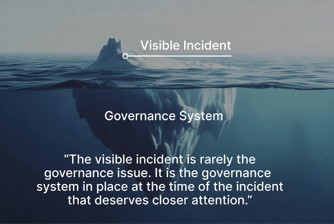
Long before officials arrived at the HOA’s gate, governance decisions had already been made. Constitutions had been drafted, Conduct Rules approved, access-control procedures implemented and assumptions quietly embedded within the HOA’s governance framework. Those decisions -- not the incident itself -- deserve closer scrutiny.
Rather than asking only whether the actions of others were lawful, prudent trustees should perhaps first ask whether their own governance arrangements had been designed with sufficient regard for the legal framework within which they operate.
Three governance questions immediately arise:
- Were the Constitution and Conduct Rules properly aligned with South African law?
- Had the governance framework been tested against foreseeable situations involving emergency services, municipal officials or authorised government officials exercising lawful powers?
- Can trustees demonstrate that these governance considerations were properly debated before the governance arrangements were approved?
Governance rarely fails because of one visible incident. More often, weaknesses emerge quietly through assumptions that remain unchallenged, risks that were never identified or governance systems that were never tested until circumstances exposed them.
People naturally focus on the incident. Good governance, however, seeks to understand the system behind the incident.
Rules alone do not create good governance
A common misconception is that comprehensive Rules automatically mean an organisation is well governed. They do not.
Rules prescribe behaviour. Governance asks whether those Rules remain lawful, balanced, proportionate and capable of achieving the purpose for which they were created. That distinction becomes particularly important in a homeowners' association.
A Constitution, Memorandum of Incorporation, Conduct Rule or access-control policy derives its authority from South African law. It follows, therefore, that none of an HOA's governing instruments can override, replace or diminish the very legal framework from which that authority originates. This principle deserves careful reflection.
Good governance requires trustees to ensure that their governing instruments do not inadvertently create legal blind spots or governance uncertainty. Properly designed, an HOA's governance framework should provide clarity rather than uncertainty, support rather than impede the lawful exercise of statutory authority, and enable trustees, members, residents, security personnel and authorised officials to discharge their respective responsibilities in a manner consistent with the applicable legal framework.
South Africa's constitutional and legislative framework carefully balances individual rights with the State's responsibility to prevent and investigate crime, enforce legislation, protect life and property, and deliver essential public services. It also distinguishes between circumstances where judicial authorisation is generally required and those where legislation authorises officials to exercise statutory powers without first obtaining a warrant. Understanding these legal distinctions is ultimately a matter for the courts and legal practitioners. Understanding what they mean for the governance of an HOA, however, is the responsibility of trustees.
Good governance is rarely accidental. It is consciously designed. Every Constitution, Conduct Rule and access-control procedure reflects a series of governance decisions. The real question is whether those decisions continue to serve the community when circumstances become exceptional rather than routine.
Trustees are not expected to be experts in constitutional law, but they are expected to exercise reasonable care, skill and diligence. That includes recognising when specialist legal advice is required and asking whether their governance framework has been tested against foreseeable risks, rather than merely routine operations.
Good governance does not expect trustees to know every answer. It does however expect them to ask better questions.
Security and governance are ‘partners’
Security measures are often viewed as protecting a community, while governance is seen as imposing rules upon it. In reality, they serve the same purpose.
Security manages operational controls to the gated community. Governance determines the principles within which those controls operate under both ordinary and exceptional circumstances. That distinction becomes particularly important when unforeseen events occur such as a medical emergency, a fire, essential municipal services, and notably, authorised government officials exercising their statutory powers.
The strongest governance systems are rarely recognised during routine operations. Their value becomes evident only when they are tested.
Governance must anticipate the foreseeable
Perhaps one of the greatest responsibilities of trustees is to think beyond normal operations. Good governance asks not only what usually happens, it also asks what could reasonably happen.
Imagine, for example, that an HOA adopts a Rule requiring authorised officials to wait at the entrance until a trustee is available to escort them through the gated community. On an ordinary day, such a Rule may appear sensible.
Now imagine an emergency physician responding to a member or resident suffering a suspected heart attack. The trustee cannot immediately be contacted, and access is delayed.
Whether legal liability would ultimately rest with the HOA, its trustees, a service provider or another party would depend upon the facts and the applicable law. The governance question, however, is much simpler:
Should prudent trustees approve governance arrangements that could reasonably delay or complicate the lawful discharge of statutory duties or emergency services in foreseeable circumstances?
Good governance anticipates foreseeable circumstances before they become governance failures.
Governance documents should evolve
An HOA Constitution, Conduct Rules and related governance instruments should never be viewed as static documents drafted once and then forgotten. Like every effective governance framework, they should evolve as legislation develops, governance practices mature and new risks emerge.
Obtaining advice from lawyers experienced in community scheme governance is important. Equally important is ensuring that trustees periodically review whether their governance framework remains aligned with both the law and the practical realities it was designed to address.
Documents alone do not create good governance. Governance capability is demonstrated by understanding governance documents, questioning them and continually improving them.
A final reflection
The recent public debate surrounding authorised government officials entering a gated community for legitimate reasons without a warrant has understandably focused on the visible incident. However, governance asks us to look beyond it.
The visible incident may be the arrival of authorised officials at the entrance to a gated community; however the invisible questions are far more important.
- What assumptions were embedded within the HOA Constitution and Conduct Rules?
- Were governance risks identified and properly debated?
- Were trustees confident that their governance framework remained fully aligned with South African law?
These are the questions that strengthen governance.
Perhaps every HOA board should periodically ask itself one final question.
If our governance system were tested tomorrow -- by a medical emergency, a lawful investigation, a fire or any other unforeseen event -- would our Constitution, Conduct Rules and governance arrangements assist those responding to fulfil their lawful responsibilities, or unintentionally stand in their way?
The objective is not to predict every possible circumstance. It is to ensure that the HOA’s governance framework remains sufficiently robust, lawful and adaptable when unforeseen circumstances arise. Good governance has the courage to ask that question before circumstances ask it on our behalf. Ultimately, good governance is not measured by how effectively an HOA closes its gates. It is measured by whether the governance system behind those gates remains lawful, balanced, proportionate and capable of withstanding scrutiny when tested.
The gates may define the physical boundary of a gated community. They do not -- and never can -- define the boundary of South African law.
END
Words: 1,549
For further information contact:
Terrance M. Booysen (CGF: Chief Executive Officer) - Cell: +27 (0)82 373 2249 / E-mail: [email protected]
Jené Palmer (CGF: Director)) - Cell: +27 (0)82 903 6757 / E-mail: [email protected]
CGF Research Institute (Pty) Ltd - Web: www.cgfresearch.co.za
Follow CGF on X: @CGFResearch
Click below to read more...