Why governance maturity must precede foreign assistance
For decades, foreign assistance has been framed as an act of goodwill - a moral response to poverty, instability, and human suffering. Yet despite hundreds of billions of dollars in aid flowing into developing economies, the lived reality for ordinary citizens in many recipient countries has often failed to improve. In many cases, it has deteriorated.
This is not because aid is inherently flawed. It is because aid has too often been extended without insisting on one prerequisite that ultimately determines whether assistance uplifts societies or entrenches failure: the missing link is verifiable governance maturity.
In a recent and unusually candid reflection, U.S. Ambassador Michael C. Gonzales to the Republic of Zambia and the U.S. Special Representative to the Common Market of Eastern and Southern Africa (COMESA) acknowledged what many policymakers, taxpayers, and citizens have quietly observed for years. His argument in respect of foreign aid is grounded in years of firsthand experience, corroborated by widely documented cases of aid perpetuating governance failures.
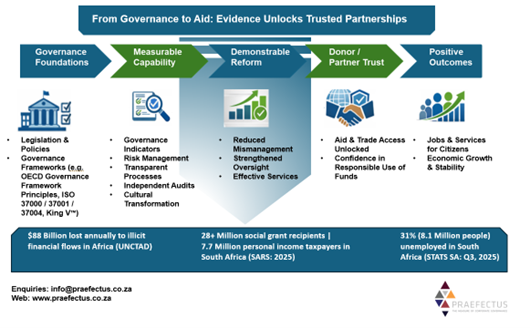
Aid flowing without demonstrated reform often cushions governance failure. According to the African Union, an estimated $88 billion exits the continent annually through corruption, tax evasion, and mismanagement compared with roughly $50 billion being received in foreign aid - Africa’s losses therefore far outweigh the assistance intended to support development. Events like Malawi’s ‘Cashgate’ scandal uncovered in 2013 underscore how unmonitored assistance can subsidise misgovernance rather than correct it.
The uncomfortable truth is that poor governance -- both in public institutions and state-linked businesses -- is rarely punished at the leadership level. Instead, ordinary citizens bear the cost through failing services, inflation, lost jobs, and declining trust in institutions. Oversight reports and parliamentary inquiries in countries like South Africa repeatedly highlight systemic failures in public procurement, state-owned enterprises, and service delivery, illustrating a persistent pattern of weak or absent accountability.
Most governments produce policies, legislation, and development plans. On paper, many align with international best practices. Many even implement governance codes -- similar in intent to South Africa’s King V™ framework -- hoping to improve ethical behaviour. Yet these frameworks often generate more rhetoric than results: tick-box reporting predominates, masked compliance is common, and lasting reform remains elusive.
What has been missing is not vision, but demonstrable governance - measurable, evidence-backed, and independently assured. Strategies and declarations alone do not guarantee results. Historically, governance has been assessed through periodic reports, self-declarations, and audits, some of which have failed spectacularly, as seen in the Steinhoff accounting scandal. Other notable examples include mismanagement in South African state-owned enterprises such as SAA, Transnet, SA Post Office, Eskom, PRASA and Denel. These typically inward-facing governance instruments, reports and declarations rarely capture how decisions are made or enforced over time.
In practice, aid is frequently approved based on what governments say they will do - rather than what they have demonstrated they can do when their own resources and political capital are at stake. Often, a sample of the outcomes of a community-based project may be proffered as evidence to substantiate the worthiness of the request for aid, but when aid is advanced the larger initiative is rarely completed in line with expectations. Corruption thrives best in these blind spots.
A different question changes everything
What if foreign assistance and trade preferences were not granted by default, but earned upfront through demonstrable governance capability?
What if eligibility for aid, concessional finance, or trade advantages required a country, department, or state-owned entity to show -- in advance -- that it could govern transparently, manage risk, enforce consequence, and sustain reform?
This is not about punishment or conditionality imposed from outside. It is about respecting sovereignty enough to insist on proof rather than on promises. Governments would no longer be treated as passive recipients of aid, able to substitute promises for performance. And citizens would no longer silently subsidise leadership failures. In South Africa, for example, social grants now reach an estimated 28 + million citizens (circa 40 % of the population) as of 2025, yet unemployment remains at circa 31 % (Q3: 2025), and procurement irregularities have cumulatively cost South Africa billions over the past decades - highlighting the human and financial consequences of governance failure.
Conversely, when assistance rewards reform already underway -- as seen in Rwanda and select Kenyan counties -- it strengthens domestic accountability, reinforces the social contract, and ensures foreign aid acts as a catalyst for growth and improvement.
Those unable to demonstrate governance maturity will find it increasingly difficult to earn trust, or the assistance that depends on it.
From governance as language to governance as capability
The missing link of good governance has always been measurement. Governance that cannot be observed or managed, cannot be tested. Governance that cannot be tested cannot be trusted. And governance that relies on trust alone inevitably drifts toward complacency and abuse.
Modern technology now makes it possible to track governance maturity continuously, in line with global standards such as ISO 37000, ISO 37001, and ISO 37004. Activities can be observed, trended, and independently corroborated, transforming governance from a retrospective report into a verifiable, operating reality. This distinction separates countries (and organisations) genuinely committed to reform from those capable only of producing reports and declarations that simulate compliance through a through a ‘tick-box’ mentality.
Evidence shows that when aid is tied to demonstrable governance improvements, outcomes improve. Programmes that make funding conditional on verified reforms -- such as the Millennium Challenge Corporation’s co-financing and conditions precedent model (aka the MCC effect) or the Gavi, The Vaccine Alliance’s performance-based co-financing model -- consistently achieve higher impact than traditional aid disbursement. Funding follows verified effort, and disbursements align with sustained performance. To this end, reform becomes a prerequisite, not a promise.
Why this matters to ordinary people
Poor governance manifests as inter alia:
- Jobs that never materialise
- Services that fail repeatedly
- Costs quietly being passed on to a thinly stretched taxbase and households
- Trust being eroded in both local leaders and international partners.
When donor nations continue to fund systems that cannot govern themselves, they unintentionally lock citizens into cycles of dependency and disappointment. Conversely, when assistance rewards reform that’s already underway, it strengthens domestic accountability and reinforces the social contract between governments and the citizens being governed.
A moment of opportunity
Institutional honesty recognises that development cannot be outsourced, subsidised indefinitely, or imposed from outside. It must be earned through leadership willing to govern differently - transparently and for all to see.
Recent patterns in international aid suggest a broader expectation among donors: trust is increasingly conditional on demonstrable, measurable governance capability. Countries that can provide evidence of sustained reform, transparency, and effective oversight are far better positioned to secure credible partnerships and aid. Those that cannot show such evidence, will find access to foreign assistance constrained, not necessarily due to political bias, but because unverified systems represent unmanageable risk.
The next evolution of foreign assistance will not be driven by larger budgets or better rhetoric. It will be driven by governance evidence – underpinned by digitised real-time governance frameworks that can be measured, tested, and independently assured. Countries that can demonstrate governance maturity will find willing, credible partners. Those that cannot, will struggle to justify why trust should precede proof.
This is not a retreat from global responsibility. It is a recommitment to it - but grounded in accountability, dignity, and mutual respect.
“Our program of foreign aid is perhaps the greatest venture in constructive statesmanship that any nation has undertaken. It is an outstanding example of cooperative endeavor for the common good.”
U.S. President Harry S. Truman, Statement upon signing the Foreign Assistance Act of 1948, Apr. 1948
The era of aid based on intent is rapidly closing. The AGOA saga is evidence of this reality, and South Africa as a case in point is already feeling the consequences, with hundreds of humanitarian offices having been closed nationally - literally impacting millions of lives.
The era of partnership based on demonstrated governance has begun. In a world of constrained capital and rising risk, governance maturity has become the new currency of trust.
END
Words: 1,306
For further information contact:
Terrance M. Booysen (CGF: Chief Executive Officer) - Cell: +27 (0)82 373 2249 / E-mail: [email protected]
Jené Palmer (CGF: Director)) - Cell: +27 (0)82 903 6757 / E-mail: [email protected]
CGF Research Institute (Pty) Ltd - Tel: +27 (0)11 476 8261 / Web: www.cgfresearch.co.za
Follow CGF on X: @CGFResearch
Click below to read more...